
How a DEWA-connected rooftop solar system works
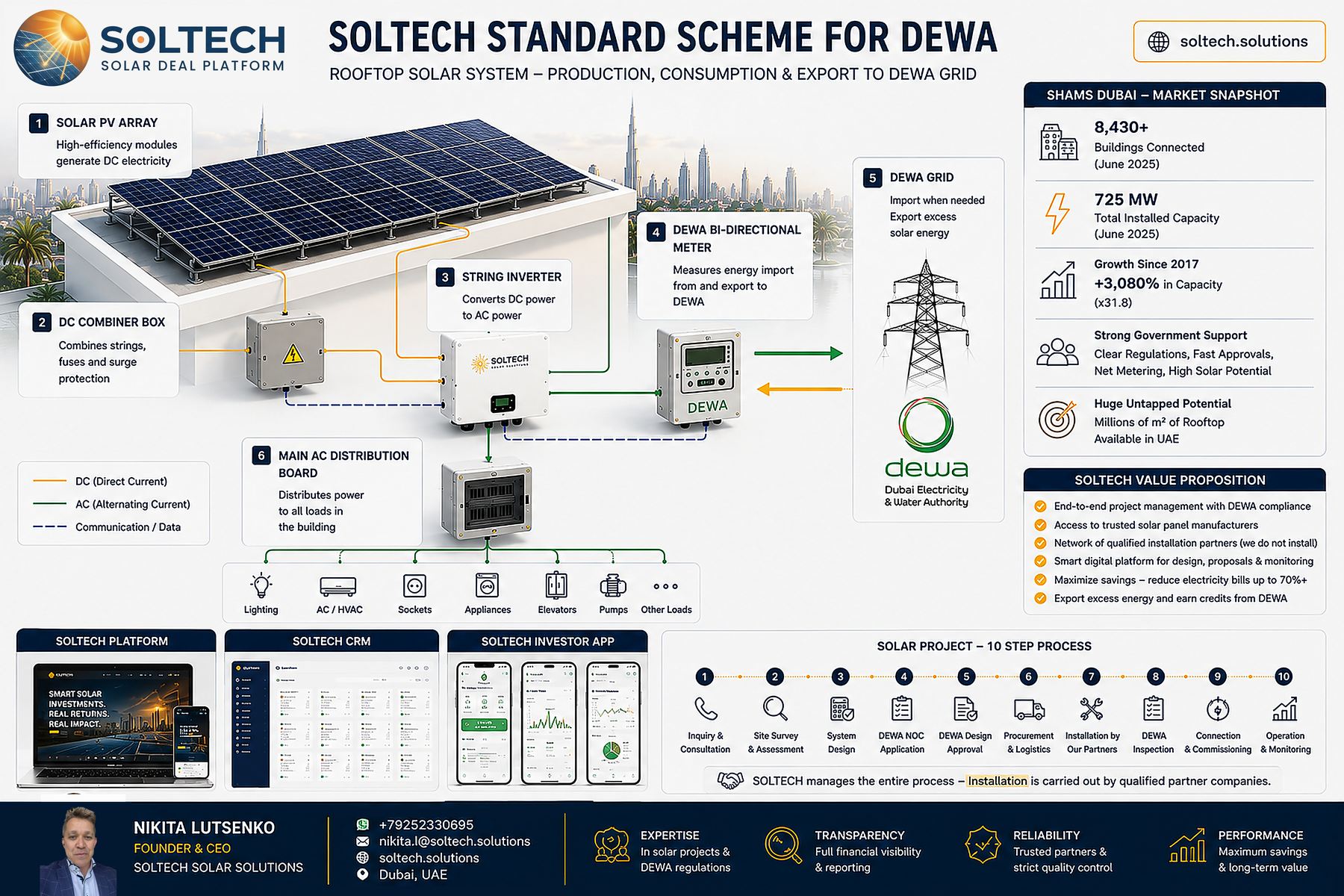
Six components stand between a Dubai roof and the DEWA grid. The single-line scheme, what each part does, and where the bi-directional meter changes the economics.
A DEWA-connected rooftop solar system has six components between the panels and the grid, and only one of them decides the economics. The array, combiner box, inverter and distribution board move electricity. The bi-directional meter is what turns surplus generation into credit under Shams Dubai net metering. The diagram above is the standard scheme SOLTECH designs to.
What each component does
| # | Component | Function |
|---|---|---|
| 1 | Solar PV array | High-efficiency modules convert sunlight into DC electricity. Output varies with irradiance, temperature and soiling. |
| 2 | DC combiner box | Brings multiple strings together and carries the string fuses and DC surge protection. The first place a fault is isolated. |
| 3 | стринговый инвертор | Converts DC to grid-synchronous AC, tracks the maximum power point, and enforces grid protection settings. |
| 4 | DEWA bi-directional meter | Measures energy imported from and exported to DEWA as two separate registers. |
| 5 | DEWA grid | Supplies the shortfall when generation is below demand and absorbs the surplus when it is above. |
| 6 | Main AC distribution board | Distributes AC to the building's loads: lighting, AC and HVAC, sockets, appliances, lifts, pumps. |
Three kinds of line run through the scheme, and confusing them is the most common error in a homeowner's mental model. DC runs only from the array through the combiner box to the inverter. AC runs from the inverter onward — to the distribution board, to the meter and to the grid. Communication and data lines carry monitoring telemetry and do not carry power at all.
Why the meter matters more than the panels
Generation and consumption happen simultaneously, and the building always consumes first. AC leaving the inverter reaches the main distribution board and is used by whatever is running at that moment. Only what is left over reaches the meter and flows out to DEWA.
That ordering is why self-consumption dominates the arithmetic. A unit consumed on site displaces a unit you would have bought at your marginal DEWA tariff slab. A unit exported becomes a credit under the net-metering rules. Under Shams Dubai these are accounted separately by the two meter registers, which is also why an oversized array on a low-consumption building does not scale savings the way the brochure arithmetic suggests.
The scheme is deliberately simple. There is no battery in the standard configuration, because net metering already lets the grid act as the store: export at midday, import in the evening, settle on the meter. Storage becomes interesting when that arrangement changes or when the site needs genuine backup, which is a different design question from the one this scheme answers.
Where DEWA sits in the process
Shams Dubai is the DEWA programme that permits this connection, operating under the Distributed Renewable Resources Generation framework. It had more than 725 MW connected across 8,430 buildings as of June 2025 — infrastructure scale rather than pilot scale. The history of how the programme got there covers the regulatory side.
Of the ten steps from first enquiry to monitoring, three involve DEWA directly: the NOC application, design approval and the inspection before connection. Those gates are also where projects stall, which is why the design has to be drawn against DEWA's rules rather than corrected afterwards. Equipment choice is part of that — inverters must appear on списке допущенного оборудования DEWA, and larger systems face a harmonic assessment before approval.
- Steps 1–3: enquiry, site survey, system design. Roof area, orientation, shading and the building's actual consumption profile decide the size. Consumption data, not roof area, is the binding constraint on most villas.
- Steps 4–5: DEWA NOC application and design approval. The single-line diagram, equipment datasheets and protection settings are submitted here.
- Steps 6–7: procurement and installation. SOLTECH manages the process; installation is carried out by qualified partner contractors certified under the DEWA framework.
- Steps 8–10: DEWA inspection, connection and commissioning, then operation and monitoring. The bi-directional meter is fitted at connection. Monitoring runs over the data link shown in the scheme.
What changes between a villa and a warehouse
The six components are the same; the sizing and the paperwork are not. On a villa the load is dominated by air conditioning and runs into the evening, so self-consumption is high in summer and the system is small enough that string layouts stay simple — see solar for villas for the residential case.
On a commercial or industrial roof the daytime load profile matches generation more closely, which raises self-consumption further, but string layouts get complicated, harmonic assessment becomes more likely, and the distribution board is rarely a single simple point of connection. The scheme above is the skeleton; a warehouse adds sub-boards, multiple inverters and often a dedicated interconnection study.
For an investor evaluating an ESCO structure, the diagram is also the asset boundary. What is being financed is items 1, 2, 3 and the cabling to the distribution board — see how the investment side is structured. The meter belongs to DEWA and the grid is not part of the deal.
Источники: Zawya — Shams Dubai rooftop solar capacity reaches 725 MW across 8,430 buildings, DEWA — Shams Dubai programme, DEWA — Harmonic Assessment (Hab-Reeh) service. Diagram: SOLTECH standard scheme for DEWA.