
Shams Dubai: from 222 to 8,430 buildings — how Dubai made the grid the battery, and why the other emirates chose a different road
 Nikita LutsenkoFounder & CEO, SOLTECH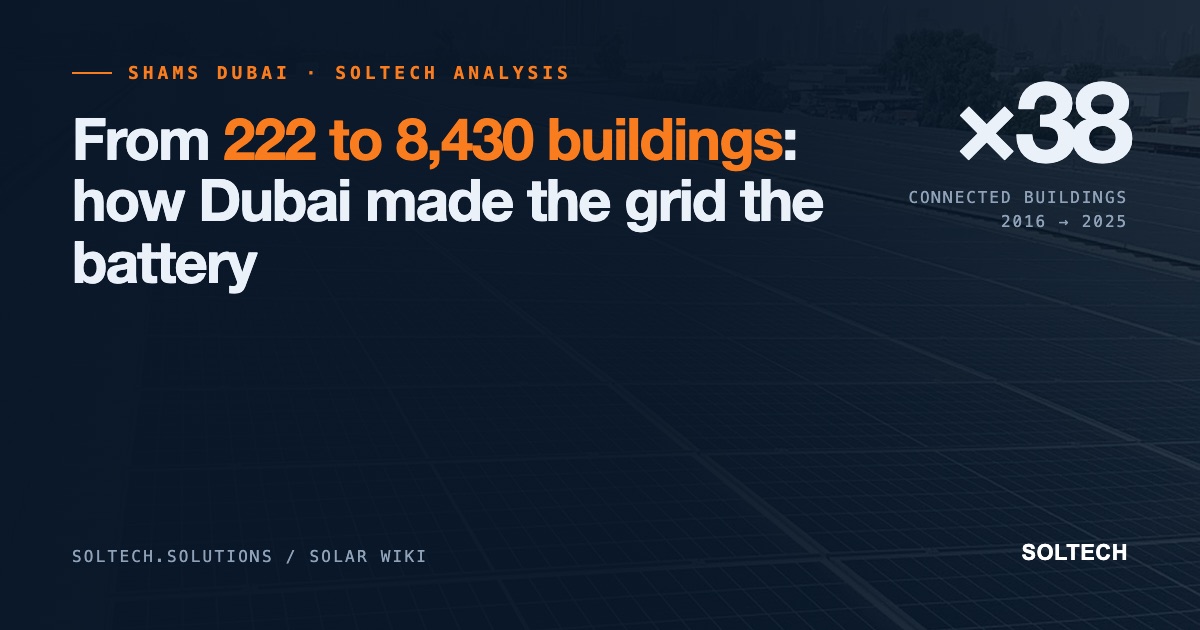
222 buildings in 2016, 5,620 in 2019, 8,430 in 2025: DEWA's published figures show one of the fastest rooftop programmes anywhere, built without subsidies and without home batteries. A SOLTECH analysis of the numbers and of why the other emirates took another road.
When Dubai's leadership launched Shams Dubai in 2015 under the Dubai Clean Energy Strategy 2050 of His Highness Sheikh Mohammed bin Rashid Al Maktoum, the emirate had no legal route for a building to feed solar power into the grid. Ten years later DEWA reports 8,430 connected buildings and more than 725 MW of rooftop capacity. No subsidy was paid, no feed-in tariff was introduced and no customer was asked to buy a battery. This article puts DEWA's published figures in one place, derives what DEWA does not publish, and explains why the design choices made in Dubai turned out to be the decisive ones.
The dynamics: 222 buildings to 8,430
DEWA reports Shams Dubai milestones irregularly, so the series below is assembled from its own announcements and from statements by its MD and CEO Saeed Mohammed Al Tayer as reported in the press. Years without a published figure are left out rather than estimated. Note that in 2019 DEWA's counting unit moved from "installations" to "sites": the October 2019 release counted 1,354 installations, the year-end figure counted 5,620 sites.
| Date | Buildings / sites | Change | Connected capacity | Source |
|---|---|---|---|---|
| Oct 2016 | 222 | — | over 6 MW | DEWA via TaiyangNews |
| Dec 2017 | 557 | +151% | 24.3 MW | DEWA, January 2020 release |
| Dec 2019 | 5,620 | +909% over two years | 164.2 MW | DEWA, January 2020 release |
| Dec 2020 | about 6,600 | +17% | about 260 MW | DEWA via Zawya / SolarQuarter |
| Mar 2021 | 6,727 | — | 298.7 MW | DEWA (Al Tayer) |
| Dec 2022 | — | — | 500 MW | Al Tayer, World Government Summit 2023 |
| 2023 | — | — | 601.8 MW | DEWA data cited in Scientific Reports (2025) |
| Jun 2025 | 8,430 | +25% since Mar 2021 | over 725 MW | DEWA |
Thirty-eight times more buildings and 120 times more capacity in under nine years. The pipeline is still filling: DEWA's Hab-Reeh design platform handled more than 1,700 connection requests in 2024, 30% more than a year earlier, and its usage grew a further 17% in the first half of 2026. For scale, the Mohammed bin Rashid Al Maktoum Solar Park, the largest single-site solar park in the world, stands at 3,860 MW. Dubai's rooftops, added one building at a time, now equal roughly one fifth of it.
Why no one in Dubai needs a battery
The single most important design decision in Shams Dubai is invisible on any roof. Under DEWA's net metering rules, every kilowatt-hour a building exports at midday is netted against the kilowatt-hours it imports in the evening, on the same bill, at the customer's own tariff, and any surplus credit carries forward to later bills. In effect DEWA's grid is the battery, and it charges nothing for the service.
That is why Dubai's rooftop programme grew without the storage market that other regions had to build first. A villa in Dubai runs its air conditioning through the night on credits earned at noon; a warehouse banks its Friday production against Monday's shift. Battery storage in these systems is an option for owners who want backup power, not a requirement for the economics. Abu Dhabi's 2026 policy, discussed below, shows what the alternative looks like: when export is not credited, storage becomes part of the base case, and the customer pays for it.
What DEWA does not publish: the shift to industrial roofs
DEWA has never split Shams Dubai by building type. But it publishes both capacity and building counts, and dividing one by the other is revealing. This is a SOLTECH calculation from the figures above, not a DEWA statistic.
- March 2021: 298.7 MW on 6,727 buildings, an average of about 44 kW per building.
- June 2025: 725 MW on 8,430 buildings, an average of about 86 kW per building.
- Between the two dates: 1,703 buildings were added and about 426 MW of capacity. That is roughly 250 kW per newly connected building.
A villa system in Dubai is typically 10 to 30 kW. A warehouse or factory roof takes 200 kW to several megawatts. The building count grew 25% in four years while capacity grew 143%: the megawatts are now coming from commercial and industrial roofs. Villas built the programme in 2016 to 2020; industry is carrying it now. This is exactly what you would expect once the DEWA slab tariff is applied to a 24-hour load: the customers with the largest daytime consumption and the flattest roofs get the shortest payback, and they have the balance sheets to move first.
Four decisions that made it work
- Credit at the customer's own tariff, carried forward. The customer never sells power below the price they buy it at, and never loses a surplus. This is the rule that removes the battery.
- No annual capacity cap. DEWA sets connection rules per site; it does not ration the programme by megawatts per year. The only limit is the number of roofs that pass design review.
- An industry, not a scheme. 111 certified companies are authorised to design and install, DEWA's eligible equipment list holds around 180 approved inverter models, and design compliance through Hab-Reeh reached 100% in 2026. A building owner can pick from a published list of enrolled contractors and expect the paperwork to clear.
- Cost-reflective retail tariffs. DEWA's residential slabs run from 23 to 38 fils per kWh and apply to all residential customers. A kilowatt-hour saved is worth the same to a household in Jumeirah as to a warehouse in Al Quoz, and the saving is large enough to pay back a system well inside the equipment's warranty period.
None of these four required public money. Shams Dubai is a regulatory achievement, not a fiscal one, and that is what makes it exportable.
The federal framework, and why the other emirates chose a different road
The UAE's leadership extended the principle nationally: Federal Decree-Law No. 17 of 2022 obliges every emirate to allow distributed renewable units to connect to the grid under unified technical requirements. What the law leaves to each emirate is the commercial question, whether and how exported power is credited, and here the emirates have made different, deliberate choices that fit their own tariff structures.
Abu Dhabi has had a Small-Scale Solar PV Energy Netting Regulation since 2017, covering systems up to 5 MW, with surplus credited in kilowatt-hours. No connected-capacity figure has been published. The reasons are structural rather than a lack of will. UAE nationals in Abu Dhabi pay a residential tariff starting at 6.7 fils per kWh, roughly a quarter of the rate paid by expatriate households and a fifth of DEWA's top slab, so for most villa owners a rooftop system has little to offset. And Abu Dhabi's single-buyer model procures utility-scale solar at world-record prices: the 2 GW Al Dhafra plant was contracted in 2020 at 1.32 US cents per kWh, about 4.8 fils. Crediting a rooftop export at a retail tariff of 20 to 30 fils when the same kilowatt-hour costs the system under 5 fils from the desert is a hard case for the utility to make. The Department of Energy's 2026 answer is coherent with that logic: the Solar Energy Self-Supply Policy, launched on 5 February 2026 and extended to villas and residential buildings on 31 March 2026, is built around on-site consumption with battery storage. Export compensation is not mentioned in either announcement. It is a storage-first route, and it will grow a storage market; it is also a more expensive route for the customer than the one Dubai took.
Sharjah has no generally available net metering scheme. The one operating example is Sharjah Sustainable City, where 280 villas in the first phase were handed over in July 2022 with rooftop PV and a net-metering arrangement agreed with SEWA for that development; the full 1,250-villa community was completed in 2023. SEWA's 2026 announcements concern transmission substations and utility plants, not customer connections.
Ajman, Umm Al Quwain, Ras Al Khaimah and Fujairah are served by EtihadWE, which announced its Distributed Solar System programme with the Ministry of Energy and Infrastructure in July 2023, starting with industrial customers. The mechanics are Dubai-like, dual metering with monthly reconciliation, with one decisive difference: surplus credits can only be used within the same calendar year. A system sized to cover a full year's consumption loses its spring surplus every December. Industry compliance guides also report an annual programme cap of 20 MW; EtihadWE has not published a cap in its own releases.
What it means for a building owner
- In Dubai, size for annual consumption and skip the battery. Because credits carry forward at the customer's own tariff, the economic optimum is a system that offsets the year's consumption, not one that maximises export. The 250 kW newcomer average shows that industrial owners have understood this.
- Outside Dubai, size for daytime self-consumption. Under Abu Dhabi's self-supply policy and EtihadWE's calendar-year credit, exported energy is worth little or nothing. The right system covers the daytime load and no more, with storage only where the evening tariff justifies it.
- Expect the other emirates to converge on batteries, not on Dubai's export credit. Abu Dhabi's 2026 policy names storage explicitly. As cell prices keep falling, that route gets cheaper every year; Dubai's route is already free.
SOLTECH prepares feasibility studies and DEWA applications for commercial and industrial sites. The sizing rules above are the ones we apply.
Sources: DEWA — Shams Dubai: clean energy for generations, January 2020 (557 buildings / 24.3 MW end-2017; 5,620 sites / 164.2 MW end-2019); Zawya — Shams Dubai reaches 725 MW across 8,430 buildings, June 2025; SolarQuarter — 725 MW, 1,700 requests in 2024, 111 companies; DEWA — Hab-Reeh usage up 17% in H1 2026; SolarQuarter — 298.7 MW and 6,727 buildings, March 2021; about 6,600 systems / 260 MW end-2020; DEWA — 1,354 installations, 125 MW, October 2019; TaiyangNews — 6 MW, 222 buildings, October 2016; DEWA — 453 buildings, October 2017; SolarQuarter — 500 MW in 2022 (World Government Summit 2023); Scientific Reports (2025) — 601.8 MW installed by 2023; SolarQuarter — solar park at 3,860 MW, July 2026; Abu Dhabi Media Office — Solar Energy Self-Supply Policy, 5 February 2026; Abu Dhabi Media Office — second phase, residential, 31 March 2026; PV Tech — Abu Dhabi net metering consultation, November 2016; pv magazine — Abu Dhabi PV standards under net metering, June 2017; PV Tech — Al Dhafra record tariff; ADDC tariffs 2026, summary; The National — Sharjah Sustainable City, June 2022; Aletihad — EtihadWE Distributed Solar System, July 2023; Technical Review Middle East — EtihadWE DSS mechanics; SurgePV — UAE solar regulations guide (20 MW cap, credit rules); Federal Decree-Law No. 17 of 2022.